
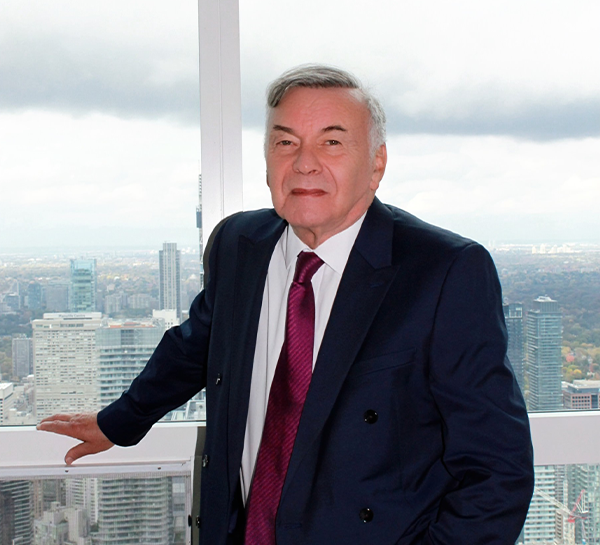
JUST PUBLISHED: I escaped the Nazis — and redefined what it means to be a refugee
Both my parents were Holocaust survivors. They were deported from Romania to two different concentration camps, survived the war, found each other again, and decided to flee communism. Their escape took them to Austria, where I was born.
My mother had suffered extreme physical hardship during the war and contracted several serious illnesses, including tuberculosis. Because of her weakened condition, she had a stillborn child before me.
We ended up in a refugee camp outside Salzburg, waiting for an opportunity to be resettled. My parents would have preferred to go to the United States, where my mother’s older brother was a medical doctor in New York, but U.S. authorities rejected our application because of my mother’s tuberculosis. And so, we waited.
While we lived in the refugee camp, neo-Nazis would occasionally amuse themselves by throwing bricks through our windows. We endured this until we were resettled. There was never any doubt in my mind—or in the minds of any of my family members, even when I was very young—that we were refugees. There was also no doubt that we had to go wherever we were permitted to go. In our case, that place was Scandinavia.
In 1955, ten years after the end of the war, we were finally allowed to resettle in Sweden. I was six-and-a-half years old when we landed at Bulltofta Airport in Malmö. I still remember my mother’s words as we walked down the aircraft stairs:
Harry, be grateful that someone has taken us in. You must do better than the Swedes, who have a natural right to be here, or you will get nowhere.
I found that to be solid advice. It guided me through many difficulties in life.
In Sweden, we were stateless. We were moved around the country according to where my father could find work. At times, this meant that we could not live together as a family while we struggled to establish economic stability.
Eventually, the family reunited in Malmö. My parents managed to rent an apartment with a living room and two bedrooms. We could not afford the rent, so one bedroom was sublet. My parents slept in the remaining bedroom, while my sister and I slept in the living room.
There were no border controls between Sweden and Denmark, but I needed a special royal permit to be allowed back into Sweden after school trips to neighbouring Copenhagen. It took us seven years to become citizens.
In the third grade, I had a kind but deeply Christian teacher. I was exempted from Christianity class and instead attended evening classes in Judaism. Twice a week, I had an hour off during the school day. On one occasion, when I returned to the schoolyard, my classmates would run up to me, chanting, “You killed Jesus.” At the time, I had no idea who that was.
The school year ended with a celebration in a church, including the singing of psalms. There was no exemption for me.
Malmö was home to one of the larger neo-Nazi movements in postwar Sweden. Jews were subjected to constant harassment, and swastikas were periodically painted outside our building’s entrance. Later, at Lund University, I encountered an openly neo-Nazi lecturer. We stared at each other during lectures, but he graded me fairly. There was nowhere to complain—and no expectation that complaining would help.
A refugee is someone who has been forced to flee their country of origin because of persecution, war, violence, or other serious threats to life and freedom. As a former refugee, I understand the instinct to seek safety above all else. My childhood also taught me that safety marks only the beginning of a much longer journey. Once immediate danger recedes, life becomes a process of rebuilding in unfamiliar surroundings. The country offering shelter brings its own history, customs and expectations, and newcomers must learn how to live within them. My mother made this clear during our first days in Sweden. We had been accepted, and that acceptance carried obligations.
Different societies and international bodies have developed different approaches to the question of what should follow initial protection. One model provides refuge and then seeks a settlement that places people back into ordinary civic life through return, integration or resettlement. Another arises where political conditions prevent any of those outcomes. In those situations, displacement continues from year to year, and refugee status can span generations. Schools, clinics and social services emerge to sustain communities that lack any other institutional framework.
My family lived through the first model. Our journey involved flight, waiting and eventual resettlement. We were stateless for years and lived from job opportunity to job opportunity. The expectation was clear: we would work, learn the language and assume the responsibilities of future citizens. Refugeehood served as a temporary condition on the way to a settled life.
Immigration debates in Western countries today often revolve around this difficult question of trajectory. The public grows unsettled when refugee groups appear to resist civic or cultural adaptation, even when such perceptions are exaggerated or unfair. Fringe militants and ideological agitators intensify these anxieties by presenting themselves as adversaries of the host society. Voters respond by supporting parties that promise tighter border controls and stricter immigration policies. This cycle harms people whose only ambition is safety, work and ongoing stability.
My upbringing encouraged tolerance and the aspiration for mutual respect. I sometimes imagine how life would have unfolded had my family remained in the Austrian camp without any route to permanence. The idea of passing refugee status from parent to child – a pattern that has developed in the Middle East due to prolonged displacement – carries a heavy psychological burden. It freezes displacement in time and transforms it into a defining identity. That was not the journey we took. We rebuilt, acquired citizenship, and became part of the country that had sheltered us.
The purpose of refugee policy should be to enable that same kind of outcome. Protection creates the space for healing. Resettlement or citizenship provides the chance to participate fully in a new society. Over time, the feeling of exile fades as work, education and belonging take root. The goal is dignity, stability and the ability to build a future that feels whole.
